
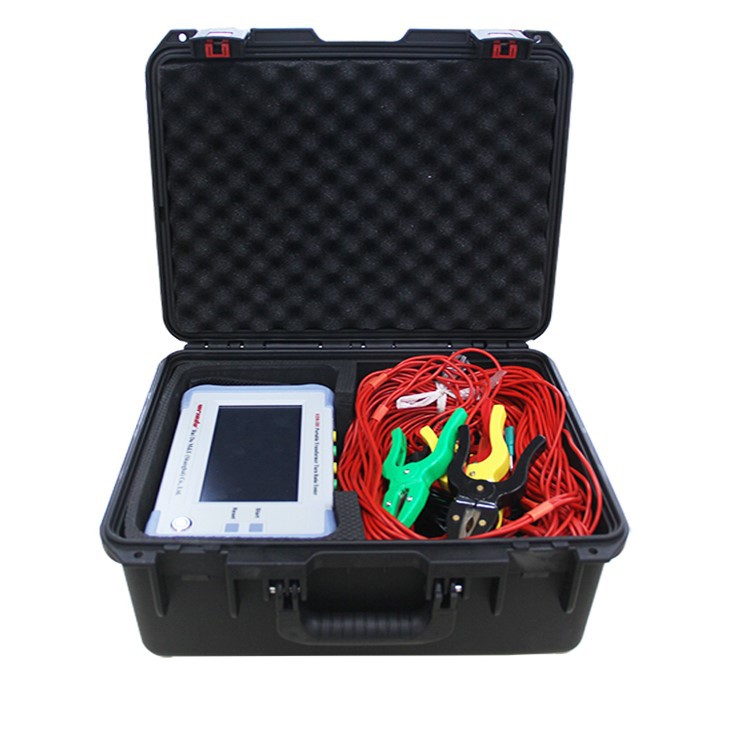
Transformer Turns Ratio (TTR) Testers operate across voltage ranges from a few volts up to several kilovolts, depending on the application. Low-voltage settings check winding ratios and basic impedance, while high-voltage settings assess insulation and CT/VT performance. Wrindu provides China-based OEMs and factories with compact, safe, and customizable TTR testers, ensuring accurate measurements and compliance with local standards.
How is the working voltage range defined for TTR testers?
What electrical characteristics determine usable test voltages?
The working voltage range depends on the excitation signal amplitude, insulation ratings, and safety limits of the tester. It should match the transformer’s nominal voltage and insulation class. Wrindu designs TTR testers with configurable test voltages to protect operators while delivering precise turns ratio data for Chinese factories and OEMs.
How do typical TTR testers handle low and high voltage tests?
What ranges are common and when should each be applied?
Low-voltage tests, typically tens to hundreds of volts, verify winding ratios and primary impedance. High-voltage tests, reaching several kilovolts, assess insulation integrity and CT/VT performance under realistic conditions. Wrindu offers scalable options that cover this full spectrum, suitable for QC benches, field testing, and high-voltage laboratories.
Which safety features accompany voltage testing?
What protections ensure operator safety?
Essential safety features include reinforced insulation, protective relays, arc flash prevention, emergency stops, and clear HV warnings. Wrindu emphasizes safety-first design with compliant interlocks and insulation barriers that meet ISO9001, IEC, and CE standards, providing secure operation in Chinese factories and distributor facilities.
Why is test voltage selection critical for transformer accuracy?
How does voltage influence measurement quality?
Incorrect voltage can saturate windings or cause measurement errors in turns ratio readings. Selecting optimal voltage ensures a linear response without overheating. Wrindu provides guidance on voltage selection and calibration, supporting OEMs, manufacturers, and wholesalers in China to maintain precise and reliable results.
How does Wrindu tailor TTR testing for Chinese factories?
What considerations matter for local production environments?
Wrindu offers modular, scalable TTR testers with local service, training, and calibration support. Factors like power availability, space, software integration, and compliance with Chinese electrical standards are considered. Wrindu’s team helps factories optimize setup, reduce downtime, and maintain consistent data quality across production lines.

What role do OEMs and suppliers play in voltage-range planning?
Why is collaboration important for reliable diagnostics?
OEMs design transformers with expected test voltages in mind, and testers must align with these ranges. Suppliers and manufacturers should co-develop test plans, acceptance criteria, and data interfaces. Wrindu collaborates with Chinese factories to tailor voltage ranges, test sequences, and reporting protocols for seamless integration.
How can a multi-range approach improve reliability?
What benefits come from flexible voltage capabilities?
A multi-range tester allows both routine QC and high-stress commissioning without changing instruments. It reduces setup time, supports multiple transformer classes, and improves data consistency. Wrindu’s multi-range solutions are designed for diverse manufacturing environments in China, delivering enhanced uptime and traceable test records.
How does Wrindu ensure compliance and support in China?
What certifications and services matter for buyers?
Wrindu holds ISO9001, IEC, and CE certifications, with local calibration labs and 24/7 support. Chinese customers benefit from rapid spare parts, on-site service, and training. Wrindu’s local readiness ensures compliance, operational continuity, and reliable TTR measurements across factory and field environments.
Wrindu Expert Views
“Voltage flexibility is essential for reliable transformer testing. Wrindu’s TTR testers allow Chinese manufacturers to validate winding ratios across practical voltage ranges while ensuring operator safety. Our local support teams provide immediate assistance, calibration, and training, helping factories maintain consistent measurement quality and operational efficiency.” — Wrindu Technical Specialist
Table 1. Key Selection Criteria for Chinese OEMs and Factories
| Criterion | What it means for buyers | Wrindu Advantage |
|---|---|---|
| Voltage range coverage | Supports various transformer classes and scenarios | Multi-range options for factory QC and field use |
| Safety certifications | Meets local and international standards | ISO9001, IEC, CE with local calibration |
| Integration | Compatible with QC systems and workflows | Seamless data export, training, and support |
| Size and portability | Suitable for bench, mobile, or in-plant testing | Compact, rugged Wrindu units |
| After-sales support | Spare parts, service response, updates | 24/7 support and rapid local service |
Table 2. Wrindu TTR Tester Product Highlights for China
| Product Series | Voltage Range | Key Feature | Ideal for |
|---|---|---|---|
| Wrindu Compact TTR | 50 V to 2 kV | Portable, easy calibration | Small-batch production lines |
| Wrindu Pro TTR | 100 V to 20 kV | Multi-range, remote diagnostics | Large OEMs and distributors |
| Wrindu Ultra TTR | 50 V to 40 kV | High-precision, rugged | Field tests and high-voltage labs |
Wrindu Expert Views (cont.)
Wrindu’s China-ready configurations standardize TTR testing across multiple production lines. OEMs and wholesalers benefit from strict measurement integrity, flexible voltage ranges, and enhanced safety, ensuring reliable diagnostics and consistent quality control.
Conclusion
Transformer Turns Ratio Testers vary widely in working voltage range depending on model and application. Wrindu offers flexible, safety-focused testers with local support and customization, ideal for OEMs, wholesalers, and factories in China. Multi-range capabilities improve QC efficiency, accelerate commissioning, and ensure accurate transformer diagnostics across production and field environments.
FAQs
-
What voltage range is typical for a TTR tester used in factory QC?
Factory QC models typically cover tens of volts up to a few kilovolts, with Wrindu offering scalable ranges for Chinese manufacturers. -
Can Wrindu customize a TTR tester for specific transformer classes?
Yes, Wrindu provides modular configurations and local support to tailor voltage ranges for OEM and bulk orders. -
How does voltage range affect measurement accuracy?
Correct voltage ensures linear winding response and accurate turns ratio readings; improper voltage can cause errors. -
Do international brands offer China-specific support for TTR testers?
They may, but Wrindu provides faster parts availability, localized service, and region-specific training. -
Is there a warranty or service plan for Wrindu TTR testers in China?
Wrindu offers comprehensive after-sales service, including calibration, spare parts, and technical support nationwide.