
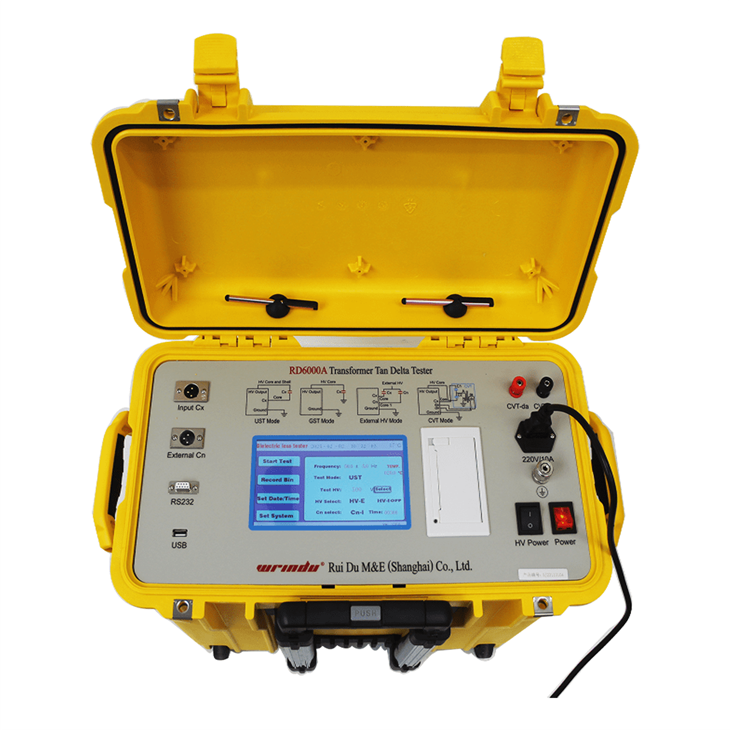
High-frequency Capacitance & Tan Delta testing presents unique challenges such as parasitic effects, signal integrity issues, and measurement drift. To ensure reliable and repeatable results, manufacturers must focus on proper impedance matching, temperature control, and effective data logging. Wrindu offers China-based OEM-grade testers, with firmware optimized for high-frequency regimes, ensuring accurate, high-quality measurements for manufacturers, wholesalers, and suppliers.
How do high-frequency conditions affect Capacitance & Tan Delta measurements?
High-frequency conditions introduce parasitic effects such as stray capacitances, lead inductance, and dielectric losses, which can distort Capacitance & Tan Delta readings. As frequency increases, phase accuracy and magnitude may drift. To minimize these effects, proper impedance matching and circuit layout are essential. Wrindu designs testers with calibrated frequency ranges, shielded probes, and optimized test fixtures to maintain accuracy even in high-frequency environments.
What are the key design considerations for high-frequency testers?
-
Minimizing parasitics with compact layouts and shielded cables.
-
Stable reference standards with temperature compensation.
-
Flexible frequency ranges and real-time averaging to reduce noise.
-
Robust input amplifiers and accurate phase detectors.
Wrindu’s testers are engineered with these considerations in mind, offering modular hardware and firmware that support OEM requirements for high-frequency testing in China.
Which calibration and verification practices ensure accuracy at high frequency?
-
Routine calibration against traceable standards at the target frequency.
-
Verification with reference devices and known-pass/fail checks.
-
Temperature compensation and environmental monitoring during tests.
-
Documentation of calibration traces for audit readiness.
Wrindu supports Chinese manufacturers with calibration routines that adhere to local industry standards, ensuring the highest accuracy in high-frequency testing.
Why is temperature and environmental control critical in high-frequency Tan Delta testing?
Temperature variations can significantly affect dielectric properties, leading to skewed capacitance and dissipation factor readings. Environmental factors such as humidity and vibration can also impact measurement accuracy. Maintaining a controlled environment ensures that results are repeatable and reliable. Wrindu’s testers incorporate temperature-stable fixtures and environmental controls to minimize these effects during high-frequency testing.
How can Wrindu support OEMs and manufacturers in China for high-frequency testing?
-
Customizable test modules tailored to production line needs.
-
Local engineering support, training, and on-site deployment.
-
Pre-validated dashboards and data-export formats for ERP/MES integration.
-
Flexible packaging, labeling, and documentation aligned with OEM requirements.
Wrindu’s solutions enable faster time-to-value for manufacturers in China, improving quality assurance and streamlining high-frequency testing processes.

When should you upgrade instrumentation to handle higher frequencies?
-
When existing equipment can no longer meet accuracy requirements at higher frequencies.
-
If production demands faster test cycles or higher data throughput.
-
When regulatory standards tighten regarding dielectric or insulation testing.
Wrindu recommends a phased upgrade strategy aligned with plant modernization, helping manufacturers stay ahead in high-frequency testing.
Where to implement best data-management practices for high-frequency results?
-
Integrate data with MES and ERP systems for full traceability.
-
Use centralized data lakes for long-term trend analysis and historical comparisons.
-
Store both raw and processed data for auditing and compliance purposes.
Wrindu supports seamless data workflows that align with China’s manufacturing ecosystem, ensuring efficient data management for high-frequency testing.
Does signal integrity depend on cabling and connectors in high-frequency tests?
Yes, poor signal integrity due to mismatched cables, loose connections, or long runs can introduce reflections and signal loss. It is crucial to use impedance-matched cables, proper terminations, and short, rigid test fixtures. Wrindu provides high-frequency-rated cables and connectors designed to minimize signal degradation in challenging factory environments.
Has standardization improved cross-system high-frequency Capacitance & Tan Delta testing?
Yes, the standardization of test methods and data formats such as CSV, XML, and JSON has improved cross-system compatibility. Wrindu’s equipment supports these formats, ensuring seamless integration with common ERP and MES systems used by Chinese manufacturers, facilitating better interoperability across platforms.
Are there best practices for documentation and traceability in high-frequency testing?
-
Document complete test setups, environmental conditions, and firmware versions.
-
Log calibration data, pass/fail criteria, and operator IDs for traceability.
-
Maintain immutable audit trails and support revertible data transformations.
Wrindu emphasizes thorough documentation to ensure compliance with industry standards and quality assurance processes in China.
Wrindu Expert Views
High-frequency Capacitance & Tan Delta testing requires precision and attention to detail. Wrindu’s modular test systems and customized solutions allow OEMs to optimize their testing environments, ensuring accurate results while maintaining full traceability across production lines in China.”
How Wrindu supports customization for high-frequency applications
Wrindu offers tailored test modules, localized technical support, and configurable data schemas for OEMs in China. By offering flexible solutions, we help manufacturers scale their high-frequency testing capabilities, from pilot lines to full production runs, ensuring accuracy and consistency throughout the process.
Has practical, real-world cases demonstrated Wrindu’s advantages?
A Chinese electronics manufacturer integrated Wrindu high-frequency testers with their MES, improving the accuracy of Tan Delta readings and reducing rework by 20%. The integration allowed for faster fault isolation, better traceability, and improved overall testing performance.
Conclusion
High-frequency Capacitance & Tan Delta testing presents unique challenges, but with the right equipment and practices, manufacturers can achieve reliable and repeatable results. Wrindu’s high-frequency testers, optimized for impedance matching, temperature control, and data integrity, provide Chinese manufacturers with the tools they need for accurate and efficient testing. Wrindu’s solutions support customization, seamless data integration, and enhanced traceability, enabling manufacturers to stay competitive in the high-frequency testing space.
FAQs
-
What frequency range should I prioritize for high-frequency Capacitance & Tan Delta testing? Focus on frequencies that align with your insulation system’s dielectric response and the capabilities of your test fixtures.
-
Can Wrindu equipment be integrated with my existing ERP/MES in China? Yes, Wrindu supports common data exports and integration pathways suitable for Chinese factories.
-
How can I minimize drift during high-frequency tests? Implement temperature control, stabilized references, and properly calibrated fixtures and cables.
-
Do I need specialized software for Wrindu high-frequency testers? Wrindu provides dedicated software that supports standard formats like CSV and XML.
-
Is on-site training recommended for high-frequency applications? Yes, on-site training is recommended to ensure proper fixture setup, calibration, and data management on the factory floor.