
Test Set Sizing: Matching Instrument Capability to the Asset Fleet
Send your test requirement — get a tailored solution and a quote within one working day.
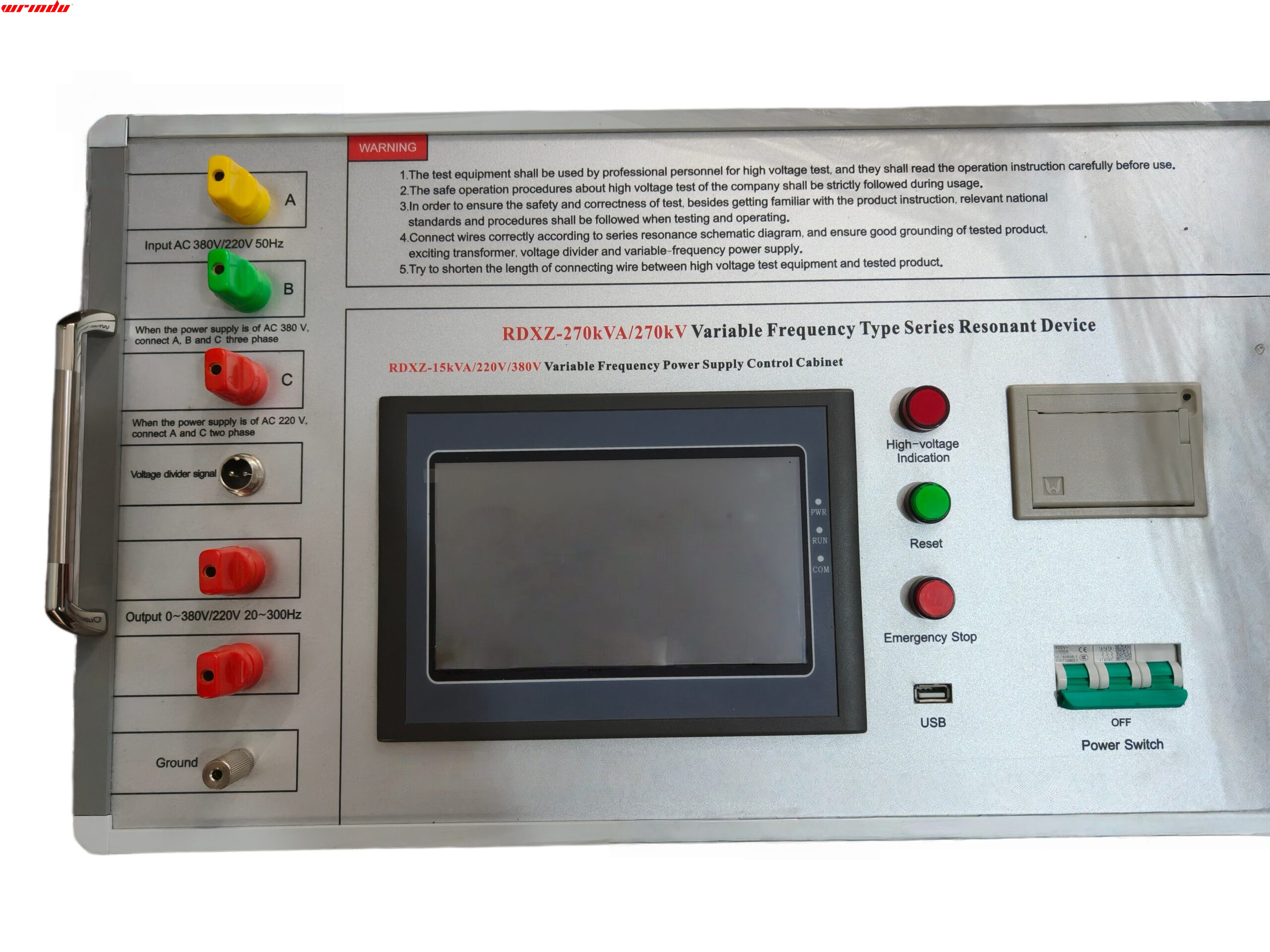
Test equipment is usually bought for a project and then used for a fleet. The project has a defined asset list and the equipment is sized to the hardest item in it; the fleet keeps changing, and the set is eventually asked to test something it was never sized for. Test set sizing asset fleet practice starts from the assets the equipment will see over its life, not from the order that happened to trigger the purchase.
The difference in approach shows up in the specification. A project-sized specification quotes the voltage and current of one asset class. A fleet-sized specification quotes the range of classes, the hardest case in each and the duty the equipment has to sustain.
Why single-project sizing usually under-buys
A project specification is written against a bill of quantities. The equipment is required to test the assets on that list, and the sizing follows the hardest item in it, with whatever margin the engineer adds.
The fleet then changes. Assets are added at a higher voltage class, the set is mobilised to a different substation, work moves from commissioning to maintenance and back, and the equipment is used for tests that were not in the original scope. Each of those changes moves the requirement.
The under-buy appears as a limitation rather than a failure: a set that cannot quite reach the test voltage on the longest circuit, or one that cannot sustain the current for the duration the test requires. Limitations of that kind are discovered on site, under schedule pressure, which is the worst place to find them.
Mapping the asset fleet you must cover
The mapping exercise produces a table, not a narrative. One row per asset class the equipment will be used on, with the parameters that determine the sizing requirement for that class.
| Equipment type | Parameters that drive sizing | Worst case to identify |
|---|---|---|
| AC withstand test set | Test voltage, load capacitance, test frequency | Longest or most capacitive circuit at the highest test voltage |
| DC high-voltage set | Test voltage, load capacitance, leakage current | Largest load at the highest test voltage |
| Primary current injection set | Test current, loop impedance, duty | Highest current through the highest impedance loop |
| Transformer test instruments | Ratings, tap range, winding configuration | Largest unit with the widest tap range |
| Battery test equipment | String voltage, discharge current, capacity | Largest string at the highest discharge rate required |
| Protection test sets | Channel count, output ranges, communication interfaces | The most demanding scheme in the portfolio |
The mapping should include assets that are expected to be added, not only those currently in service. A programme that will add a higher voltage class or a longer cable route within the equipment’s life belongs in the table.
Voltage class and capacitance as the primary axes
For equipment that applies a voltage, the two primary axes are the test voltage and the capacitance of the load. Together they determine the charging current, which determines whether the set can reach the test voltage and sustain it for the duration the test requires.
The relationship is proportional: the current required grows with frequency, with capacitance and with voltage. A set that meets the test voltage on a short circuit may not meet it on a long one, and the difference between the two can be an order of magnitude.
This is why a sizing exercise that quotes only the maximum voltage is incomplete. The requirement is the test voltage at the maximum capacitance in the fleet, which is a specific combination rather than two independent figures. The field test framework that governs the applied voltage is published as IEC 60060-3, and the cable classes whose capacitance drives these calculations are defined in IEC 60502-2 for medium voltage extruded cables and in IEC 60840 for the higher voltage classes.
Current and duty cycle requirements
For equipment that injects a current, the requirement is the current through the load, which is set by the loop impedance of the circuit it has to pass through. Sizing against a short-circuit current figure produces a set that may be unable to deliver its rating into the real circuit.
Duty cycle determines whether the set can complete a sequence. A set rated for a short-time current is limited by heat, and a test programme that requires several measurements in succession may exceed the thermal capability unless the sequence is planned around the duty.
The two requirements should be stated together in the specification: the current at the impedance, and the number and duration of applications per sequence with the recovery time available between them.
Growth margin versus over-specification
A margin is justified where the fleet is expected to change; it is not justified as a general safety factor. The cost of the margin is paid twice, once in purchase and once every time the equipment is mobilised, because larger equipment is heavier and needs more space and lifting.
The useful question is what the fleet will contain over the life of the equipment. If a higher voltage class is planned, the fleet has effectively already grown and the sizing should reflect it. If not, a set sized well above the current maximum is capability that will rarely be used.
The reverse risk is equally real. A set sized at the current maximum becomes inadequate the first time a larger asset is added, and the alternative at that point is either to hire equipment for the occasional large job or to replace the set earlier than planned.
Where a single set cannot cover the fleet
A single set cannot cover the fleet efficiently when the range is wide at both ends. A set sized for the largest asset is heavy and awkward on small work, and the mobilisation cost of using it for routine small tests can exceed the value of the test.
The split usually appears between large transmission-class work and routine distribution work, or between a bench configuration for workshop testing and a portable configuration for site work. Each of those is a genuine distinction that a single set compromises on.
The alternative to a second set is to hire for the occasional large job. Whether that is cheaper depends on how often the large job occurs and on the mobilisation cost of hiring, including the lead time, which for specialist high-voltage equipment can be significant.
Where the fleet includes paper-insulated cable alongside extruded cable, the method difference is a separate reason for more than one set: the applicable method differs by insulation type, and a single set cannot cover both. The cable classes are defined in IEC 60502-2 and IEC 60840, and the switchgear requirements that determine test voltages for installed equipment are in IEC 62271-1.

Cost comparison across configurations
The comparison should be made over the equipment life rather than at purchase. One set sized for the whole fleet, two sets split by range, or one set plus hired equipment for the extremes all have different total costs, and the difference includes mobilisation, calibration, spares and the availability of the equipment when it is needed.
The mobilisation cost is often the decisive term. A set that is large enough for the whole fleet but is mobilised to small jobs carries its size with it every time, and the cost of that appears in transport, lifting and setup time rather than in the purchase price.
The availability term matters for a maintenance programme with fixed outage windows. Equipment that has to be hired for the large jobs introduces a lead time into the outage planning, and that lead time may not be compatible with the window.
Presenting the sizing case to procurement
The case reads as a chain of consequences: the fleet determines the range, the range determines the worst case, the worst case determines the capability, and the duty determines the thermal requirement. Presented that way, the specification is a consequence of the assets rather than a preference.
The asset table does the persuasive work. A procurement reviewer who can see the assets the equipment has to cover, and the worst case in each class, can follow why a particular rating was specified and can question the assumption if they disagree with it.
Where the sizing includes a margin for expected growth, that assumption should be stated explicitly. A margin whose basis is visible can be reviewed; one that appears as an unexplained rating is the item most likely to be cut during cost reduction, which is how a correctly sized requirement becomes an undersized purchase. Support and training arrangements that form part of the delivered package are described under testing services and OEM/ODM solutions, and the equipment range the sizing applies to is listed under all electrical testing equipment and grouped on the high-voltage insulation withstand test hub.
Sizing on the hardest asset in the next project produces equipment that becomes inadequate as soon as the fleet changes.
Send your asset list with voltage classes, capacitance and current requirements to our engineering team and we will turn it into a sizing table. Withstand test systems and their sizing ranges are grouped on the high-voltage insulation withstand test hub.
FAQ
Why does sizing on a single project under-buy?
Because a project has a defined asset list and the equipment is sized to the hardest item in it, while a fleet changes. New assets are added, work moves between substations and the set is asked to cover circuits it was never sized for. Sizing on the fleet, including the items that are expected to be added, produces equipment that remains usable as the fleet evolves.
Which axes matter most in sizing?
Voltage class and capacitance for equipment that applies a test voltage, and current and loop impedance for equipment that injects a current. On top of those, the duty cycle matters because it determines whether the set can complete a sequence of tests without reaching a thermal limit.
How much growth margin is reasonable?
Enough to cover the assets the fleet is expected to contain over the equipment lifetime, and no more. A margin costs money in both purchase and transport; a set sized well above the fleet rarely reaches its capability, while a set sized at the current maximum becomes inadequate the first time a larger asset is added.
When should two sets be bought instead of one?
When the fleet contains assets at the extremes of a wide range, particularly where one end requires a large set and the other requires portability. A single set sized for the largest asset is heavy and awkward on the small ones, and the cost of the second set is often less than the cost of mobilising the large one for small work.
How is the sizing case presented to procurement?
As a link between the asset list and the requirement. The fleet determines the range and the worst-case load; the worst-case load determines the capability; and the duty determines the thermal requirement. Presented that way, the specification reads as a consequence of the assets rather than as a preference for a particular configuration.
Related articles
 SF6 Leak Detector Sensitivity: Select a Method for the Inspection TaskKnowledge
 Cable Fault Locator Selection for Urban Networks: Routes, Noise and AccessKnowledge
 Substation Battery Load Bank Sizing: Duty, Voltage Range and Heat RejectionKnowledge
 CT Polarity, Ratio and Burden Testing: Find Wiring and Loading ErrorsKnowledge