
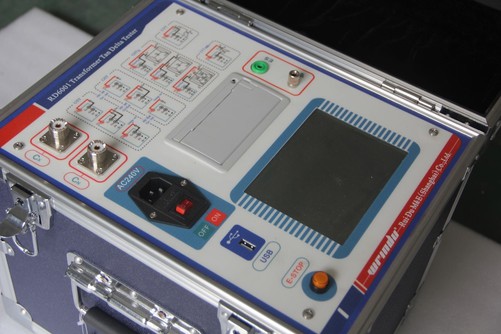
A transformer tan delta test set measures insulation quality by assessing dielectric loss and capacitance at variable frequencies, providing critical insights into transformer health. Chinese manufacturers such as Wrindu deliver advanced, accurate, and interference-resistant tan delta testers designed for OEM, wholesale, and factory applications worldwide.
What Is a Transformer Tan Delta Test Set?
A transformer tan delta test set is specialized equipment used to measure the dielectric loss tangent (tan δ) and capacitance of transformer insulation systems. It evaluates insulation degradation due to moisture, aging, or contamination, offering predictive maintenance capabilities to prevent failures and enhance system reliability.
How Does a Tan Delta Test Set Work on Transformers?
The test set generates a high-voltage test source through an internal inverter or power supply, applies it to the transformer winding, and measures the phase angle difference between current and voltage. Advanced models, like Wrindu’s RD6001, use digital notch filters to minimize power frequency interference, enabling accurate dielectric loss and capacitance measurements.
Which Key Specifications Define the Performance of a Transformer Tan Delta Test Set?
Key specifications include:
-
Voltage output range: typically 0.5 kV to 10 kV, sometimes higher
-
Maximum load capacity (VA): around 1500 VA or more for high-capacity transformers
-
Measurement accuracy: ±(reading × 1.0% + 0.040%) or better for tan delta
-
Capacitance range: from low pF to several hundred nF depending on the voltage
-
Frequency range: standard power frequencies (50/60 Hz) and variable frequencies (e.g., 45-65 Hz)
-
Noise suppression capabilities: digital filters for reducing interference, essential in substations
-
Data storage: capacity for hundreds of test records with USB or external storage support
-
Power supply requirements: typically AC 220V, 50Hz with ±10% tolerance
Why Are Features Like Frequency Conversion and Digital Filtering Crucial?
Frequency conversion technology allows the test set to vary the applied frequency, optimizing test sensitivity and mitigating errors from stray capacitance or external interference. Digital notch filtering significantly enhances measurement reliability in electromagnetic noisy environments such as substations or power plants, a feature highlighted in Wrindu’s test sets.
Where Are Transformer Tan Delta Test Sets Commonly Used?
These test sets are fundamental in power plants, electrical substations, transformer manufacturing and maintenance facilities globally. Chinese OEMs and wholesale suppliers like Wrindu produce equipment suitable for laboratory bench testing and onsite field diagnostics under challenging conditions.
When Should Transformer Tan Delta Testing Be Performed?
Testing is typically conducted during factory acceptance, routine maintenance, and after repairs or refurbishments. Frequency depends on asset criticality and operating conditions but usually ranges from annually to every few years to monitor insulation health proactively.
Who Benefits Most from Transformer Tan Delta Test Sets?
Power utilities, transformer manufacturers, electrical testing laboratories, and maintenance contractors benefit extensively. OEM manufacturers and suppliers in China partner with Wrindu to supply high-performance testers catering to precise industrial and utility requirements worldwide.
How Does Wrindu’s Transformer Tan Delta Test Set Stand Out?
Wrindu’s RD6001 features a compact integrated design housing a dielectric loss bridge, variable frequency voltage regulator, step-up transformer, and SF6 standard capacitor for stability. It supports various test modes, intuitive touchscreen operation, comprehensive data management, and robust safety protections tailored for high-interference environments, making it ideal for modern power system diagnostics.
Are Customization and Support Available?
Yes, Wrindu offers customizable test sets including tailored voltage ranges, frequency settings, software interfaces, and communication options. Their professional team provides consultation, fast delivery, calibration services, and 24/7 after-sales support, ensuring clients receive optimal testing solutions aligned with evolving market needs.
Table: Main Technical Specifications of Wrindu RD6001 Transformer Tan Delta Test Set
| Specification | Description |
|---|---|
| Voltage output | 0.5 kV to 10 kV (adjustable) |
| Load capacity (VA) | 1500 VA |
| Measurement accuracy | ±(reading × 1.0% + 0.040%) for tan delta |
| Capacitance range | 3 pF to 1.5 µF (depending on voltage) |
| Frequency range | 45 Hz to 65 Hz with variable settings |
| Noise suppression | Digital notch filter for 50 Hz interference |
| Data storage | 200 test groups; USB data export |
| Power supply | AC 220 V ±10%, 50 Hz |
| Interface | Full touchscreen LCD display |
Wrindu Expert Views
“Precision and reliability define the effectiveness of transformer tan delta testing,” explains a Wrindu technical specialist. “Our RD6001 test set integrates advanced frequency conversion and digital filtering technologies to ensure accurate dielectric loss measurements, even in high electromagnetic interference environments. Wrindu’s commitment to innovation assures clients in China and worldwide receive trusted solutions that enhance transformer monitoring and grid reliability.”
Conclusion
The main technical specifications of a transformer tan delta test set revolve around adjustable high-voltage output, accurate dielectric loss and capacitance measurement, variable frequency capabilities, and robust interference suppression technologies. Wrindu, as a leading Chinese manufacturer, offers cutting-edge test sets that meet these rigorous demands. Investing in quality tan delta test equipment is essential for proactive transformer maintenance and reliable electrical system operation.
Frequently Asked Questions
What voltage range does a typical transformer tan delta test set cover?
Usually from 0.5 kV up to 10 kV or higher depending on model and application.
Why is frequency flexibility important in tan delta testing?
Variable frequency improves test sensitivity and reduces errors from stray or external capacitance.
How does digital notch filtering improve test results?
It suppresses power frequency interference enabling accurate dielectric loss measurements in noisy environments.
Can Wrindu’s test set operate in harsh substation conditions?
Yes, Wrindu’s design includes strong anti-interference capability and robust protection features.
Is data management integrated into modern tan delta test sets?
Yes, comprehensive data storage, report printing, and USB data export are standard features.