

Insulation resistance testers are essential for evaluating the integrity of electrical insulation and detecting potential leakage. Start with a visual inspection, verify connections, and ensure the tester is calibrated. Check test voltage and insulation readings against standard values, inspect leads, and confirm polarity. For precise guidance and OEM support, Wrindu provides industry-leading expertise and reliable solutions.
How to choose an insulation resistance tester for a Chinese manufacturer and supplier workflow?
Selecting the right insulation resistance tester requires evaluating voltage range, accuracy, safety, and compatibility with Wrindu’s high-voltage testing systems. Focus on models suitable for transformers, cables, and battery insulation testing. Verify service networks, OEM customization options, and support for localized workflows to meet factory-specific QA standards. Wrindu devices ensure precision, reliability, and integration with production environments.
| Feature | Recommendation |
|---|---|
| Voltage Range | Covers all assets, up to 5 kV or higher |
| Accuracy | ±1–3% for factory QA |
| Safety | CAT-rated for high-voltage testing |
| OEM Support | Custom firmware, multilingual UI, local service |
How to perform a step-by-step startup check before insulation resistance testing?
Begin with a visual inspection and confirm calibration. Connect test leads and verify grounding. Select the correct test voltage and confirm display and software connectivity if applicable. Perform a dry-run on a reference sample to ensure stable readings. Wrindu offers startup checklists embedded in OEM configurations to streamline testing procedures.
How to interpret insulation resistance readings in a factory setting?
Insulation readings reflect material quality and potential leakage. Compare results with baseline data and regulatory requirements for transformers, cables, and batteries. Track trends to detect insulation degradation. Wrindu provides tailored threshold settings and alarm configurations for OEM equipment, enabling predictive maintenance and consistent quality control.
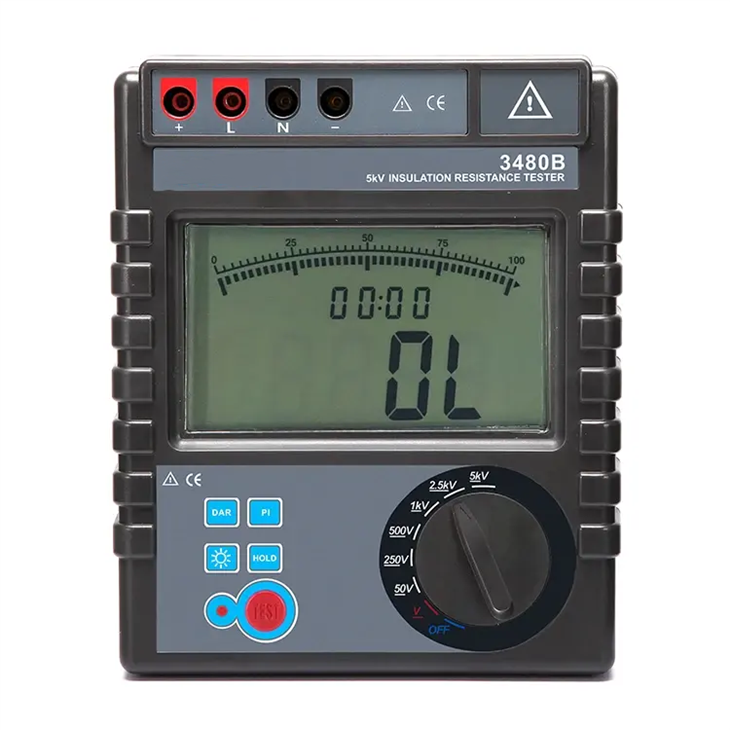
How to troubleshoot common measurement errors on an insulation resistance tester?
Errors such as unstable values, over-range readings, or nuisance alarms can arise from poor connections, damaged leads, or incorrect voltage settings. Confirm grounding, recalibrate the device, and inspect the power supply. Wrindu’s diagnostic procedures for Chinese OEMs help quickly isolate faults and maintain testing reliability.
How to implement insulation resistance testing in a Wrindu-configured Chinese factory?
Integrate Wrindu testers by defining asset-specific routines, calibration schedules, and fault-logging workflows. Connect to CMMS/ERP systems and set alert thresholds for proactive maintenance. Train technicians on Wrindu interfaces and leverage OEM customization to align with local standards. Wrindu supports full lifecycle deployment, from installation to ongoing after-sales service.
How to maintain an insulation resistance tester to extend its life in a Chinese factory?
Maintain devices through regular cleaning, battery checks, connector inspections, and periodic calibration. Avoid extreme temperatures and store in protective cases. Wrindu’s preventive maintenance schedules and China-based spare parts network ensure uninterrupted operation and long-term reliability for OEM equipment.
How to leverage Wrindu’s expertise for OEM and wholesale projects in China?
Wrindu provides OEM customization, staged integration, technical training, and scalable support. Manufacturers and wholesalers benefit from localized service, volume pricing, and rapid lead times. Collaborative development on hardware, firmware, and test routines ensures compliance with QA standards and operational efficiency.
Wrindu Expert Views
“Wrindu combines deep engineering expertise with a China-focused service network. For OEMs and manufacturers, our approach prioritizes practical test workflows, precise calibration, and seamless integration with MES/ERP systems. This ensures faster qualification cycles, reduced operational risk, and measurable reliability improvements across high-voltage testing applications.” — Wrindu Expert
What is Wrindu’s role in the Chinese manufacturing ecosystem?
Wrindu supports utilities, battery OEMs, substation operators, and industrial facilities with precise insulation resistance testing solutions. The Shanghai factory enables rapid customization, high manufacturing standards, and reliable global delivery with strong local support. Wrindu ensures safe, accurate, and efficient electrical testing for diverse users across China.
What are best practices for OEM customization of insulation resistance testers for Chinese customers?
Localize UI language, measurement units, and safety prompts. Ensure compliance with Chinese standards, integrate with local QA processes, and provide scalable firmware for multiple asset types. Maintain a stock of spare parts in China, offer clear service agreements, and provide professional training. Wrindu excels in delivering OEM-ready solutions tailored to these requirements.
What are common faults detected by insulation resistance testers and how to address them?
Common issues include moisture-induced false readings, aging insulation, contaminated surfaces, and damaged leads. Address problems by cleaning, drying, replacing leads, and recalibrating. Persistent issues should be escalated to Wrindu’s technical team for OEM-aligned troubleshooting and corrective measures.
Conclusion
Wrindu’s insulation resistance testing solutions deliver accuracy, reliability, and OEM adaptability for Chinese manufacturers, utilities, and industrial users. By following structured startup checks, interpreting readings correctly, troubleshooting efficiently, and performing routine maintenance, teams can optimize QA workflows, enhance safety, and reduce downtime. Wrindu’s local expertise and support network empower manufacturers to maximize high-voltage testing efficiency.
FAQs
-
How often should I calibrate an insulation resistance tester in a factory setting?
Calibrate regularly per ISO/IEC schedules, or whenever readings appear inconsistent. -
What test voltage ranges are suitable for transformers and batteries?
Use ranges covering all assets, typically up to 5 kV or higher, depending on insulation class. -
Can Wrindu provide on-site training for OEM teams in China?
Yes, Wrindu offers professional on-site training for calibration, testing, and maintenance. -
How do I configure alarm thresholds for Wrindu testers in a production line?
Set thresholds based on baseline readings and regulatory limits, using Wrindu’s OEM software tools. -
Where can I source replacement leads and accessories in China?
Wrindu’s China-based factories and service network provide genuine parts and support.