
How to Choose a Transformer Turns Ratio Tester
Send your test requirement — get a tailored solution and a quote within one working day.
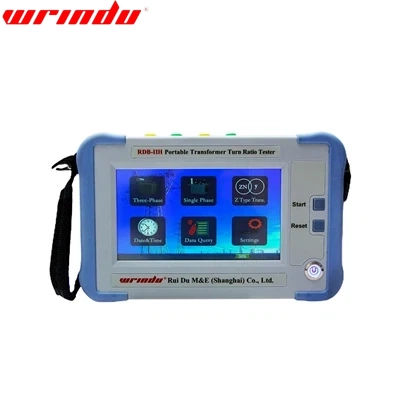
Choosing a transformer turns ratio (TTR) tester means matching the instrument to the transformers you test, the decisions you will make from the ratio results, and the conditions in which you work. The selection inputs are the transformer population and tap range, the accuracy and test voltage you need, single- or three-phase support, safety ratings, interference resistance, data handling and calibration records.
Build a written specification before comparing price lists, because catalog numbers only become comparable when their conditions are stated.
Define the Transformer Population Before Choosing a Tester
Start with the assets the tester must cover, not with a preferred brand or model. List the transformer voltage classes, ratings, vector groups and tap-changing arrangements that appear in your routine work. A workshop that tests single-phase distribution units has different needs from a substation team that tests large three-phase power transformers with on-load tap changers.
The practical questions are simple: what is the highest and lowest turns ratio you must measure, which tap positions must be covered, and do you test energized or de-energized circuits only? Turns ratio testers apply a low-voltage excitation and measure the induced secondary voltage, so the range of ratios you need is driven by the nameplate ratios in your fleet. A specification that says “wide ratio range” is not useful unless it names the range and the accuracy at the extremes, where most instruments are least accurate.
Reading the Specification: Ratio Range, Accuracy and Test Voltage
Manufacturers express accuracy in different ways. A statement such as “±0.1%” tells you little until you know the ratio at which it applies, the temperature range, the supply conditions, the settling time and whether the figure includes lead and connection effects. Compare instruments on the same basis: ratio accuracy at a defined point, repeatability, and the uncertainty you actually need for your acceptance criteria.
Factory and site acceptance criteria for ratio deviation, such as those found in the applicable edition of IEC 60076-1 or the equivalent IEEE transformer standard, are written for the transformer class and the instrument conditions. That is why a tester that is adequate for a small distribution transformer may not give you defensible numbers on a large power transformer, where the acceptable deviation band is tighter and small setup errors matter more. The test voltage also deserves attention: a higher excitation voltage can improve the signal-to-noise ratio on low-ratio windings, while a very low voltage may not represent the core condition that matters for your comparison.
Single-Phase or Three-Phase TTR Testing Needs
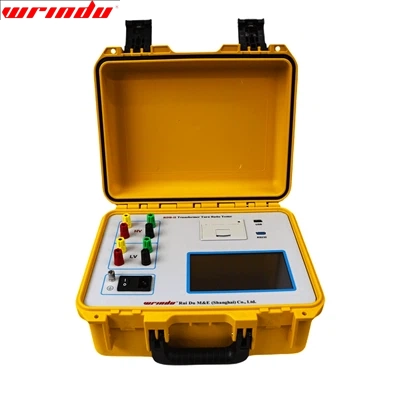
Ratio testing can be performed phase by phase with a single-phase instrument or automatically across all three phases with a three-phase tester. Three-phase testers reduce test time on three-phase transformers, which matters when you test many units or when each phase must be measured at several tap positions. They also help you see phase-to-phase consistency in one pass, which is useful for catching wiring or tap-position errors early.
Single-phase instruments remain practical for single-phase transformers, instrument transformers, and field work where a compact unit is more valuable than speed. The decision should come from your workload, not from a belief that one configuration is always superior. If your fleet mixes both types, confirm how the tester handles vector groups and whether the software can apply the correct phase relationships for common groups such as Dyn11 and Yd11.
Field Conditions, Safety Ratings and Interference Resistance
Portable testers are used in substations, on transformers that have recently been de-energized, and in environments where adjacent energized plant can inject interference. Check that the instrument and its leads are rated for the environment in which they will be used. Equipment intended for work near energized plant is typically marked with a category such as CAT III or CAT IV, and the correct category depends on the installation you work on; confirm the rating with the manufacturer documentation and your own site rules.
Interference resistance is part of field accuracy. Long test leads, nearby power-frequency fields, and poor contact at the terminals can all move a ratio reading. Look for testers that tolerate lead resistance, detect poor connections, and give stable readings quickly. Kelvin-style or guarded connections reduce the effect of lead and contact resistance, and are worth checking on the specification sheet rather than assuming they are included.
Data Handling, Reporting and Calibration Records
A ratio test is only as valuable as the record it produces. Confirm how the instrument stores results, whether it can export them in a format your reporting system accepts, and whether the software supports the fields you need for a defensible test record: transformer identification, tap position, measured ratio, deviation, test conditions, date and operator. Some instruments allow you to build report templates so that the same information appears consistently on every job.
Calibration records are part of the selection decision. Ask what calibration the instrument requires, at what interval, and what the certificate covers. A tester whose accuracy you cannot trace to a calibration standard is difficult to defend in an acceptance report. Record the calibration date and the reference used, and build the interval into your equipment maintenance plan.
A Turns Ratio Tester Request-for-Quotation Checklist
| Requirement | What to ask | Why it matters |
|---|---|---|
| Ratio range | What is the covered range and the accuracy at the upper and lower ends? | The extremes define whether your largest and smallest transformers can be measured defensibly. |
| Accuracy and repeatability | At which ratio, temperature and settling time is the figure valid? | Catalog accuracy without conditions is not comparable between vendors. |
| Test voltage | What excitation voltages are available and how are they selected? | Signal-to-noise and core excitation behaviour depend on the applied voltage. |
| Phase configuration | Single-phase, three-phase, or both? | Determines test time and workflow on three-phase units. |
| Vector group support | How are Dyn, Yd and other groups handled? | Avoids manual phase-relationship errors on common vector groups. |
| Safety category and leads | What category rating, lead design and connection check is provided? | Field use near energized plant demands correct ratings and stable connections. |
| Data and reporting | How are results stored and exported? | Records are what make a test defensible in an acceptance report. |
| Calibration | What calibration is required and what does the certificate cover? | Traceability protects the value of every measurement. |
Use the checklist as the basis of your request for quotation. Fill in the transformer population you defined in the first step, and ask every vendor to answer the same questions in the same units. When responses differ, compare the conditions behind the numbers instead of the numbers alone.
Ask for a practical demonstration before you commit. A tester can look excellent on paper and behave differently on the transformers you actually own: slow settling on a large winding, unstable readings on a windy substation roof, or a report format that does not fit your records. Bring a sample transformer or a known test object, measure it with the candidate instrument, and compare the result with your reference measurement. Test the export function on the spot and confirm that the report contains the fields your procedure requires. The demonstration is also the moment to evaluate the leads, the clamps and the practical details that no specification sheet describes, such as how easily the tester connects to bushings at awkward angles and how clearly it warns when a connection is poor.
Frequently Asked Questions
What accuracy does a turns ratio tester need?
The accuracy you need depends on the acceptance tolerance that applies to the transformer class you test and on the uncertainty you can tolerate in the field. A catalog figure such as ±0.1% is meaningful only with the ratio, temperature and settling conditions stated. Compare instruments on the same basis and confirm the figure against your own acceptance criteria before purchase.
Is three-phase testing worth the extra cost?
Three-phase testing saves time when you regularly test three-phase power and distribution transformers at multiple tap positions, and it shows phase-to-phase consistency in one pass. If most of your work is single-phase or instrument transformers, a compact single-phase tester may be the better match. Choose according to your workload rather than assuming one configuration is always superior.
What safety category should a portable ratio tester have?
The correct category depends on the installation you work on and your site rules. Instruments intended for work near energized plant are typically marked CAT III or CAT IV; confirm the rating in the manufacturer documentation and match it to your own working environment. The tester rating is only one part of the safety chain, which also includes isolation, verification and discharge discipline.
Once the specification is clear, match the requirement to a suitable transformer ratio test system on the ratio test equipment page, or compare the full test programme in What Tests Are Required for a Power Transformer. For interpreting the results the instrument produces, see How to Interpret Transformer Turns Ratio Test Results.
Related articles
 SF6 Leak Detector Sensitivity: Select a Method for the Inspection TaskKnowledge
 Cable Fault Locator Selection for Urban Networks: Routes, Noise and AccessKnowledge
 Substation Battery Load Bank Sizing: Duty, Voltage Range and Heat RejectionKnowledge
 CT Polarity, Ratio and Burden Testing: Find Wiring and Loading ErrorsKnowledge