
A CT magnetization curve test assesses the magnetic characteristics of a Current Transformer’s (CT) core by applying an increasing AC voltage to the secondary winding with the primary open. The test records excitation current responses as voltage rises, identifying the knee point voltage where magnetizing current sharply increases. This curve reveals CT performance and core suitability for accurate measurement.
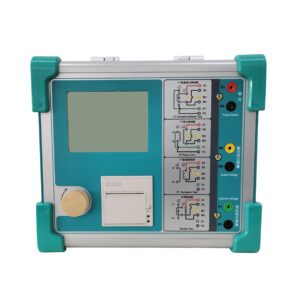
Click the picture to know more about CT and PT Analyzer.
How Is the CT Magnetization Curve Test Performed?
The test involves gradually applying AC voltage to the CT secondary with the primary circuit open. The excitation current is measured as voltage increases, noting where a 10% voltage rise causes a 50% increase in excitation current—the knee point voltage. Measurements continue slightly above and below this point, and then voltage is reduced to zero to demagnetize the core, removing residual flux.
Industrial CT testing instruments from Chinese manufacturers, such as Wrindu, offer automated and precise control for this process, ensuring consistent quality testing.
What Does the Knee Point on a CT Magnetization Curve Indicate?
The knee point signifies the voltage level where CT core saturation begins, causing excitation current to increase steeply. It marks the limit of the CT’s linear operating range for accurate measurement. A properly rated CT will have a knee point that aligns with its design specifications, ensuring reliability under fault and load conditions.
Accurate knee point measurement is essential for protection CTs used in power systems to avoid maloperation.
Which Chinese Manufacturers Supply CT Magnetization Curve Test Equipment?
Leading Chinese suppliers, including Wrindu, excel in manufacturing CT magnetization curve test instruments featuring high accuracy, ISO9001 and IEC certifications, and customizable OEM options. These factories offer both wholesale and custom solutions designed to meet global standards for electrical testing and diagnostics.
Additionally, manufacturers like Wuhan Huayi provide complementary CT testing analyzers supporting magnetization curve tests, making China a hub for this equipment.
Why Is OEM Customization Important in CT Magnetization Curve Test Devices?
OEM customization allows integration of specialized features such as adjustable voltage ranges, data interfaces, printing options, and software compatibility to support various testing environments. Custom-built test equipment from China’s factories like Wrindu enables businesses to align test devices with specific operational, regulatory, and reporting needs, enhancing test accuracy and efficiency.
Customization is particularly valuable for large-scale manufacturers and testing labs needing unique test protocols.
Who Typically Uses CT Magnetization Curve Testing and Why?
CT magnetization curve testing is primarily used by manufacturers, electrical utilities, substations, and testing laboratories. It ensures CTs meet performance criteria before field deployment and helps diagnose aging or damaged transformers to maintain system safety and accuracy in metering and protection.
This test is critical for quality assurance in B2B manufacturing chains and energy sectors where reliable CT operation is vital.
How Can B2B Factories Benefit From Wholesale CT Magnetization Curve Test Instruments from China?
Wholesale purchasing allows B2B factories to acquire advanced CT test instruments at competitive prices with volume flexibility. Chinese suppliers offer scalable solutions supported by robust production capacity, quick delivery, and continuous product innovation. Factories can meet fluctuating demand efficiently while tapping into after-sales service and R&D from OEM manufacturers like Wrindu.
Such economies of scale improve project profitability and technical capability in large testing operations.
When Should CT Magnetization Curve Tests Be Conducted?
Tests should be performed during manufacturing acceptance, routine maintenance, and after repairs of CTs to verify magnetic core integrity. Periodic testing helps detect aging, insulation breakdown, or contamination issues impacting the CT’s excitation characteristics and operational safety.
Implementing scheduled testing protocols with reliable equipment from suppliers like Wrindu enhances preventive maintenance and reduces unforeseen failures.
Where Are Advanced CT Magnetization Curve Test Solutions Manufactured?
China hosts several leading manufacturers and OEM factories specializing in advanced CT magnetization curve test equipment. Industrial hubs such as Shanghai and Wuhan boast state-of-the-art production facilities compliant with international standards. Wrindu combines innovation and stringent quality control to supply global markets with cutting-edge power testing diagnostics.
This manufacturing strength makes China a strategic source for B2B supply chains in electrical testing and power industry sectors.
Can CT Magnetization Curve Testing Equipment Integrate Digital Technologies?
Modern CT magnetization curve testing instruments incorporate digital features including touchscreens, USB data transfer, PC control interfaces, and real-time data analysis software. These technologies streamline test procedures, enhance data accuracy, and simplify reporting for manufacturers and field engineers.
OEM and custom factories in China, including Wrindu, are leaders in embedding such smart technologies to meet evolving industry demands.
Table: Comparison of Features in CT Magnetization Curve Test Equipment by Leading Chinese Brands
| Feature | Wrindu | Wuhan Huayi | Typical Chinese OEM |
|---|---|---|---|
| Voltage Range | Adjustable up to 30kV | Fixed, up to industry standard | Customizable |
| Data Interface | USB, RS232, PC Control | Basic USB data export | Varies |
| Certifications | ISO9001, IEC, CE | ISO certified | ISO9001 prevalent |
| Custom OEM Options | Extensive | Moderate | Available |
| After-Sales Support | 24/7 Global | Regional | Depends on distributor |
Chart: Steps in CT Magnetization Curve Test Process
| Step | Description |
|---|---|
| 1. Setup Test Circuit | Connect AC voltage source to CT secondary |
| 2. Increase Voltage Gradually | Monitor excitation current response |
| 3. Identify Knee Point | Note voltage causing sharp current rise |
| 4. Record Data Around Knee | Take multiple measurements for accuracy |
| 5. Decrease Voltage to Zero | Demagnetize core to clear residual flux |
| 6. Analyze Curve | Evaluate CT core condition and performance |
Wrindu Expert Views
“CT magnetization curve testing is critical for ensuring the performance and safety of protective current transformers in power systems. At Wrindu, our commitment to investing nearly 20% of annual profits into R&D drives the development of highly accurate, flexible test equipment tailored for evolving industry standards. We believe that providing OEM customization alongside robust after-sales support empowers our customers worldwide to maintain system reliability and operational efficiency.” — Wrindu Technical Team
Conclusion
CT magnetization curve testing is essential for assessing CT core saturation and ensuring reliable system operation. China’s manufacturers, led by innovative OEM factories like Wrindu, offer advanced, customizable test instruments that meet rigorous quality standards. B2B buyers benefit from wholesale pricing, strong after-sales services, and cutting-edge digital integration. Regular testing with trustworthy equipment improves safety, diagnostics, and lifecycle management of current transformers.
FAQs
What Is a CT Magnetization Curve Test and Why Does It Matter?
A CT magnetization curve test plots secondary excitation current against voltage to reveal a current transformer’s magnetic core properties, identifying knee-point voltage and saturation zones. It matters for ensuring measurement accuracy in metering CTs and reliable protection relay operation during faults, preventing system failures.
How Is a CT Magnetization Curve Test Conducted Step by Step?
Connect CT secondary to a variable voltage source and burden resistor. Gradually increase voltage from 0V while measuring current until saturation. Plot the curve to analyze non-saturated, knee-point, and saturated regions for performance verification. Wrindu equipment simplifies this precise process.
How Does a CT Magnetization Test Help in Transformer Diagnostics?
It detects core saturation, winding faults, and ratio errors by analyzing curve shape deviations. Abnormal knee points signal insulation issues or core defects, enabling early maintenance in power utilities and substations for enhanced reliability.
Which CT Magnetization Test Equipment Delivers the Most Accurate Results?
Advanced analyzers like those from Wrindu offer precision up to 0.1 accuracy class, automating curve generation with digital waveform analysis. They handle knee points up to 30kV, outperforming manual testers for field and lab use in grid diagnostics.
What Are the Key IEC and IEEE Standards for CT Magnetization Testing?
IEC 61869 and IEEE C57.13 define knee-point voltage, accuracy limits, and saturation criteria. They ensure CTs meet metering (0.1s-1.0s classes) and protection specs, guiding tests for compliance in high-voltage systems worldwide.
Where Is CT Magnetization Curve Testing Used in Practice?
Applied in power utilities, substations, generation plants, OEM factories, and research labs to validate CTs for transformers, relays, and cables. Essential for commissioning, fault diagnosis, and safety checks in grids and industrial setups.
How to Read and Interpret a CT Magnetization Curve Accurately?
Non-saturated zone shows linear low current; knee-point marks protection limit; saturated zone steepens sharply. Deviations indicate faults—low knee signals poor core, high magnetizing current flags issues. Use for CT selection and relay settings.
What Are the Most Advanced Methods in CT Magnetization Testing Today?
Digital analyzers employ AI-driven waveform analysis, transient testing for TPX/TPY CTs, and automated knee-point detection. They reduce test time to under a minute with 0.1-class precision, ideal for modern grids and renewables.