
Wrindu Completes Successful Participation in Middle East Energy 2026 in Dubai
Send your test requirement — get a tailored solution and a quote within one working day.
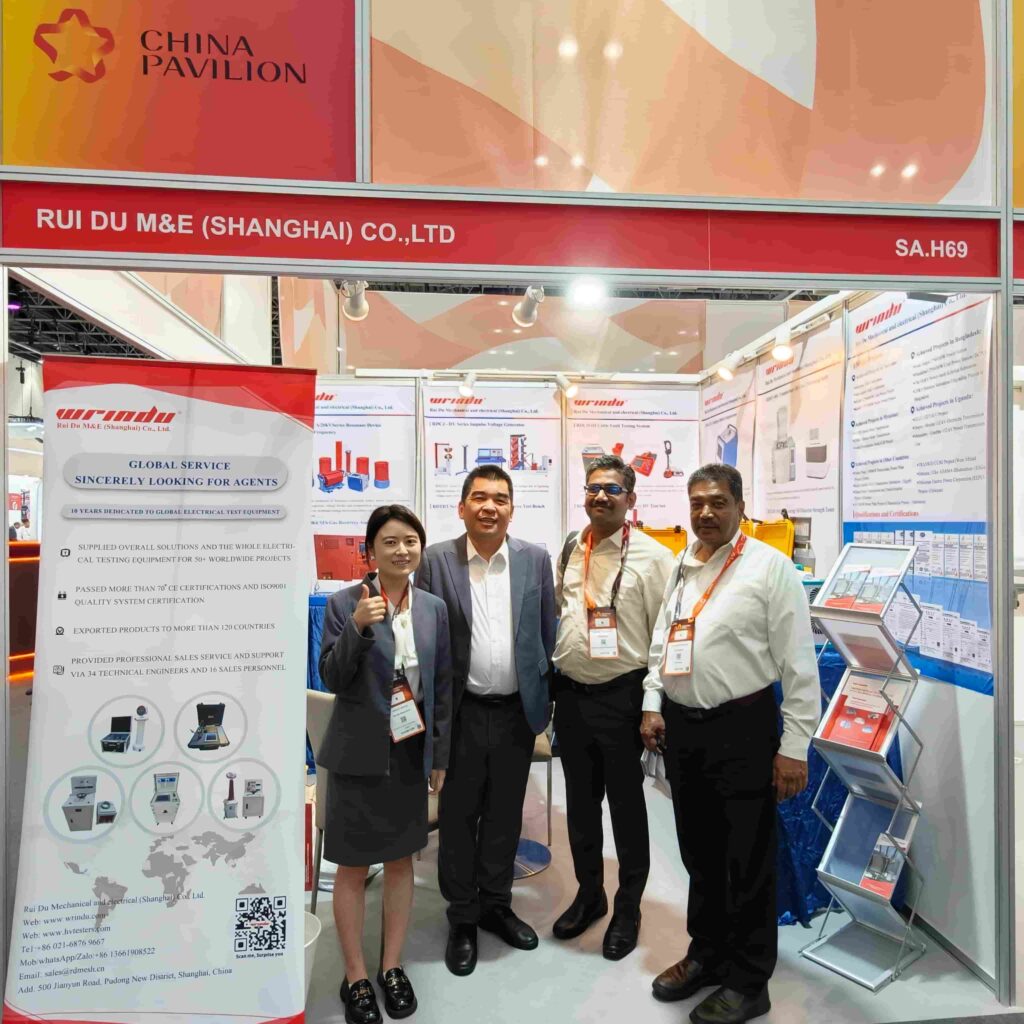
Wrindu has successfully completed its three-day participation in Middle East Energy (MEE) 2026, which took place from September 1 to 3, 2026, at Dubai World Trade Centre (DWTC). The exhibition brought together power companies, electrical contractors, engineers, testing specialists, utility representatives, and industry partners from the Middle East and many other regions.
During the event, the Wrindu team welcomed visitors at Booth SA.H69 and introduced a wide range of high-voltage testing solutions for electrical power systems.
The exhibition gave Wrindu an opportunity to meet customers face to face, understand their field testing needs, and discuss practical ways to improve the safety, reliability, and efficiency of power equipment maintenance.


What High-Voltage Testing Equipment Did Wrindu Present?
Wrindu presented testing solutions covering several important areas of power equipment maintenance.
The product range discussed with visitors included transformer testing equipment, insulation resistance testers, transformer oil testing equipment, partial discharge testing systems, cable testing equipment, and high-voltage withstand test equipment.
These solutions are used for testing and diagnosing transformers, substations, power cables, switchgear, and other high-voltage electrical equipment.
Many visitors were interested in how different testing methods can work together. Instead of using only one test, engineers can select different tests according to the equipment type and the problem they need to investigate.
What Electrical Testing Problems Were Customers Most Concerned About?
Many discussions at the Wrindu booth focused on real problems faced by power maintenance teams.
One major concern was the early detection of insulation problems. Electrical insulation can become weaker over time because of aging, moisture, contamination, electrical stress, and other operating conditions. If these problems are not found early, they may eventually lead to equipment failure or an unexpected power outage.
Another frequent topic was fast cable fault location. When an underground power cable fails, finding the exact fault point can take considerable time. For utilities and electrical contractors, accurate fault distance measurement and cable path detection can make troubleshooting faster and reduce unnecessary excavation.
Visitors also asked about transformer condition monitoring and testing. Regular electrical and oil tests can provide useful information about transformer condition and help maintenance teams decide when further inspection or maintenance may be required.
Why Is Transformer Testing Important for Power Utilities?
Transformers are among the most important assets in substations and transmission and distribution networks. A transformer problem can affect the stability of the power supply and may result in expensive repairs and downtime.
At MEE 2026, customers showed interest in several transformer testing methods, including winding resistance testing, transformer turns ratio testing, insulation resistance testing, tan delta testing, and transformer oil testing.
Each method provides different information. Electrical tests can help engineers check winding and insulation conditions, while oil tests can provide information about the quality and condition of transformer insulating oil.
For maintenance teams, the main challenge is to select a suitable test based on the transformer type, voltage level, testing purpose, and actual operating condition.
How Can Cable Testing Help Reduce Power Outages?
Underground cables are widely used in modern cities and power distribution systems. Their condition can change over time due to aging, moisture, mechanical damage, poor cable joints, and continuous electrical stress.
If cable insulation problems are not detected early, they can develop into serious faults and cause unexpected interruptions.
During MEE 2026, visitors discussed cable insulation testing, VLF testing, cable fault pre-location, cable path detection, and accurate fault location.
A complete cable testing solution can help engineers answer two important questions: Does the cable have a fault, and where is the fault located?
Accurate fault location can reduce troubleshooting time, limit unnecessary digging, and help maintenance teams restore power more quickly.
Why Are Insulation and Partial Discharge Tests Important?
The early identification of insulation defects was another important topic during the exhibition.
Partial discharge is a local electrical discharge that can occur in a small weak area of an insulation system. Repeated partial discharge activity can gradually damage insulation and may increase the risk of electrical failure.
For this reason, partial discharge testing and insulation diagnostics are useful tools for condition-based maintenance of high-voltage equipment.
Many customers are moving away from a purely reactive maintenance approach. Instead of waiting for equipment to fail, they want to identify potential problems earlier and take action before a major fault occurs.
What Features Do Engineers Look for in Test Equipment?
The conversations at MEE 2026 also showed that customers are looking beyond basic voltage and measurement specifications when selecting high-voltage testing equipment.
For on-site testing, engineers commonly consider:
- Operator safety and protection
- Stable and accurate measurements
- Simple operation
- Clear test results
- Easy transportation and field use
- Fast testing and fault diagnosis
- Automatic testing and data storage
- Reliable operation in different environments
- Support for different electrical equipment and applications
For field testing teams, practical operation is especially important. Equipment that is easy to set up, operate, and transport can help engineers complete testing work more efficiently.
How Can Electrical Testing Support Preventive Maintenance?
Another important point discussed at the exhibition was the increasing use of preventive and condition-based maintenance.
Power utilities and industrial facilities cannot always wait until a transformer, cable, or other electrical asset fails. Regular testing allows engineers to identify abnormal conditions at an earlier stage and make maintenance decisions based on test results.
Different tests provide different types of information. Electrical measurements, insulation tests, transformer oil analysis, partial discharge testing, and cable diagnostics can be used together to build a clearer picture of equipment condition.
This approach can help reduce unexpected failures, improve maintenance planning, and support longer service life for critical power assets.
What Did Wrindu Learn from MEE 2026?
MEE 2026 was also an important opportunity for Wrindu to communicate directly with professionals from different power markets.
At Booth SA.H69, discussions covered a wide range of applications, including substation testing, transformer diagnostics, cable fault location, insulation testing, and high-voltage withstand testing.
Customers shared different requirements based on their projects, equipment types, voltage levels, working environments, testing standards, and maintenance goals.
These conversations showed once again that there is no single testing solution for every application. The right equipment should be selected according to the actual testing task and operating conditions.
What Does the Future of Power Testing Look Like?
The successful completion of MEE 2026 is another important step in Wrindu’s continued communication with the international power industry.
As power networks grow and electrical equipment faces longer operating periods and more demanding conditions, effective testing and condition assessment will become increasingly important.
Wrindu will continue to focus on the development and supply of high-voltage testing equipment and electrical diagnostic solutions for power utilities, substations, electrical contractors, industrial facilities, and professional testing organizations.
We would like to sincerely thank everyone who visited Wrindu Booth SA.H69 during Middle East Energy 2026. We appreciate the valuable technical discussions, customer feedback, and business opportunities shared during the exhibition.
Thank you for meeting Wrindu in Dubai. We look forward to continuing to work with power industry professionals worldwide and providing practical testing solutions for safer, more reliable, and more efficient power systems.


