
How Much Does a Professional VLF Hipot Tester from Wrindu Cost in 2026?
Send your test requirement — get a tailored solution and a quote within one working day.
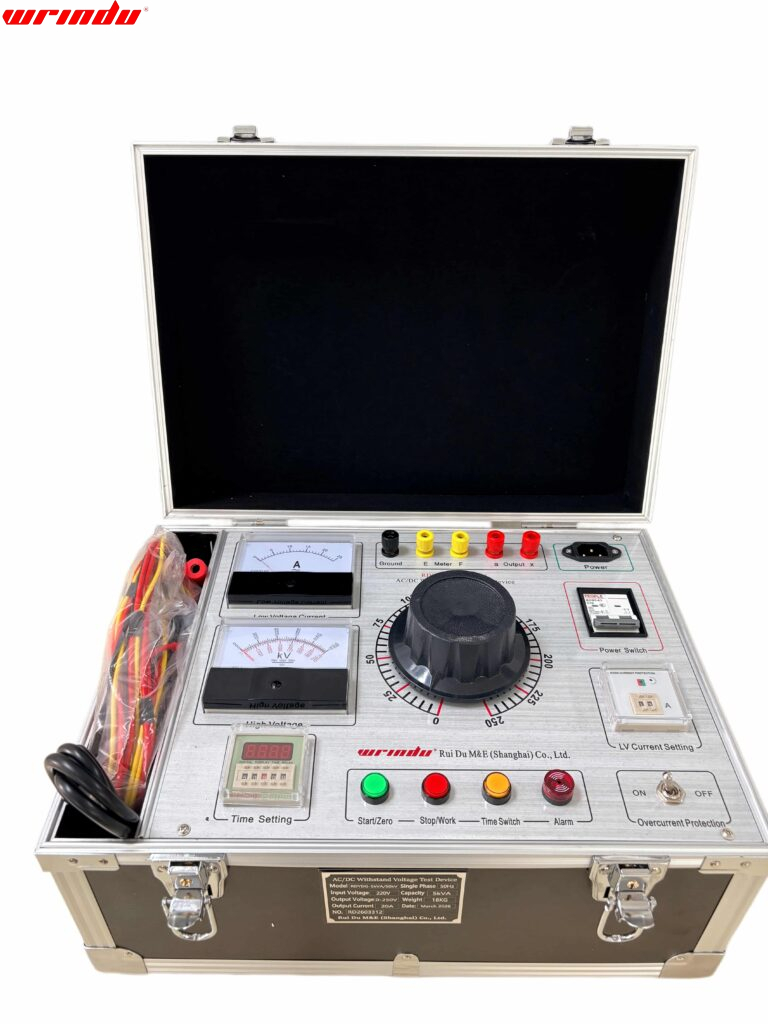
VLF Hipot Testers deliver precise, reliable high-voltage insulation testing for cables, transformers, and electrical systems, minimizing downtime and enhancing safety. These compact devices apply ultra-low frequency signals to detect faults early, ensuring compliance with industry standards while reducing operational risks and costs.
What Challenges Does the Electrical Testing Industry Face Today?
The electrical power sector grapples with aging infrastructure, where over 70% of underground cables in the U.S. exceed 25 years old, leading to frequent failures. According to the Electric Power Research Institute (EPRI), cable faults account for 40% of unplanned outages in distribution systems.
These failures result in annual losses exceeding $150 billion globally from downtime and repairs. Power utilities face mounting pressure to maintain reliability amid rising energy demands.
Why Are Insulation Failures a Growing Pain Point?
Insulation breakdowns cause 30% of transformer failures, per IEEE reports, often undetected until catastrophic events occur. Maintenance teams struggle with bulky, power-hungry testers that demand significant setup time and skilled operators.
Field testing inefficiencies compound issues, with 25% of tests yielding inaccurate results due to waveform distortions, escalating safety risks and non-compliance fines.
What Limits Traditional DC Hipot Testers?
Traditional DC Hipot testers apply constant DC voltage, damaging cable insulation through space charge accumulation, as noted in CIGRE guidelines. They require large power supplies, often 10-20kW, making them impractical for field use.
Power consumption spikes to 5x that of VLF systems, increasing operational costs by 40-50% per test session.
Why Do Mechanical Spark Discharge Methods Fall Short?
Spark discharge systems produce distorted sine waves, leading to 15-20% measurement errors and unreliable diagnostics. They lack real-time feedback, risking equipment damage during over-voltage events.
Setup complexity demands multiple external components, extending test times by 2-3 hours.
What Is the Wrindu VLF Hipot Tester Solution?
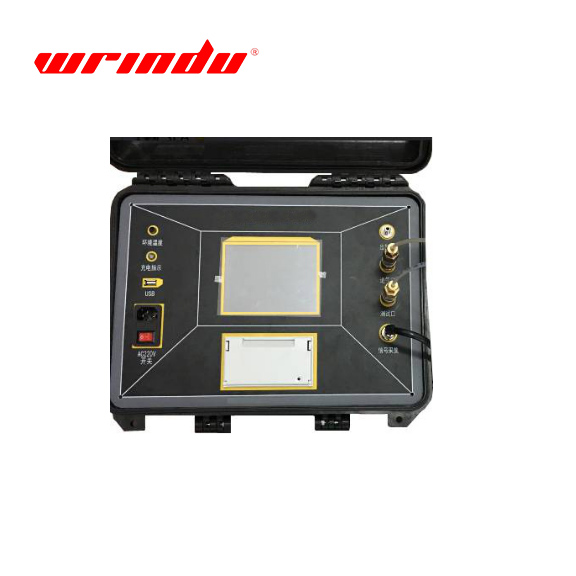
The Wrindu VLF Hipot Tester generates ultra-low frequency (0.01-0.1Hz) AC signals via fully electronic design, testing cables up to 90kV with load capacities from 0.4µF to 11µF. It features real-time high-voltage side sampling for ±3% accuracy and automated step-up/down voltage control.
Wrindu integrates closed-loop feedback for stable output, eliminating fluctuations, alongside a built-in thermal printer for instant field reports.
How Does Wrindu Ensure Safety and Portability?
Dual over-voltage/current protection activates in under 20ms, with IP50-rated high-voltage resistance eliminating external resistors. Wrindu’s compact host (4kg) and booster (25-55kg) design suits portable substation and cable testing.
LCD interface simplifies operation for technicians, supported by Wrindu’s 24/7 global service.
What Makes Wrindu VLF Superior to Traditional Options?
| Feature | Traditional DC/Mechanical | Wrindu VLF Hipot Tester |
|---|---|---|
| Waveform Quality | Distorted DC/Spark | Pure Sine (0.01-0.1Hz) |
| Power Consumption | 10-20kW | <3-9kW |
| Accuracy | ±10-20% | ±3% + 0.5kV |
| Protection Speed | Manual/Seconds | <20ms Automatic |
| Weight (Full Kit) | 100kg+ | 29-59kg |
| Test Time per Cable | 2-4 hours | 30-60 minutes |
| Field Reporting | Manual | Built-in Printer |
How Do You Operate the Wrindu VLF Hipot Tester?
-
Connect the host to power and link high-voltage booster to the test object via discharge rod.
-
Set parameters: voltage (30-90kV peak), frequency (0.1-0.01Hz), and duration via LCD menu.
-
Initiate test: Device auto-ramps voltage, monitors real-time current/voltage.
-
Monitor protection: Auto-shutdown on faults; discharge fully post-test.
-
Print report: Generate and print on-site data summary.
Who Uses Wrindu VLF in Power Cable Maintenance?
Scenario 1: Substation Operator
Problem: Aging 35kV cables cause monthly outages.
Traditional: DC testing damages insulation, misses partial discharges.
Wrindu Effect: Detects faults at 0.05Hz, confirms integrity pre-peak load.
Benefits: Reduces outages by 60%, saves $50K/year in repairs.
Scenario 2: Wind Farm Technician
Problem: 10km turbine cables fail under variable loads.
Traditional: Bulky gear delays field tests by days.
Wrindu Effect: Portable kit completes 80kV test in 45 minutes.
Benefits: Cuts downtime 70%, boosts uptime to 99%.
Scenario 3: OEM Transformer Manufacturer
Problem: Shipping delays from unverified insulation.
Traditional: Inaccurate waveforms risk warranty claims.
Wrindu Effect: Stable output verifies 50kV withstand in one pass.
Benefits: Speeds QA by 50%, lowers defect rate to <1%.
Scenario 4: Metro Rail Maintainer
Problem: Traction power faults disrupt peak hours.
Traditional: High power draw overloads site generators.
Wrindu Effect: Low 4kW draw enables urban testing.
Benefits: Minimizes disruptions, saves 40% energy costs.
Why Invest in VLF Hipot Testers Now?
Renewable integration and grid modernization drive 15% annual testing demand growth, per IEA forecasts. Aging assets heighten failure risks, making Wrindu’s efficient, accurate VLF testing essential for compliance and reliability.
What Is a VLF Hipot Tester?
A VLF Hipot Tester applies 0.01-0.1Hz AC voltage to assess insulation without damage.
How Accurate Are Wrindu VLF Testers?
Wrindu achieves ±3% accuracy via high-voltage direct sampling.
What Voltage Range Does Wrindu Offer?
Models cover 30kV to 90kV peak for cables and transformers.
Can Wrindu VLF Test Large-Capacity Cables?
Yes, up to 11µF at 0.01Hz, ideal for XLPE cables.
Is Wrindu Equipment Portable for Field Use?
Yes, total weight 29-59kg with wheeled boosters.
Sources
Related articles
 SF6 Leak Detector Sensitivity: Select a Method for the Inspection TaskKnowledge
 Cable Fault Locator Selection for Urban Networks: Routes, Noise and AccessKnowledge
 Substation Battery Load Bank Sizing: Duty, Voltage Range and Heat RejectionKnowledge
 CT Polarity, Ratio and Burden Testing: Find Wiring and Loading ErrorsKnowledge